
Memorial Day
No partisan politics today, loyal readers.
Today, Duffy remembers and celebrates only what binds us together; that at the end of the day, we are all Americans.
A few years back I started a personal tradition of thanking service members during Memorial Day weekend.
This year, making an extra run to the Safeway for hamburger buns on Friday night, I eyed an Air Force Lieutenant Colonel and cornered him on Express check-out line. When I tapped him on the shoulder, he eyed me with a mix of suspicion and menace. When I thanked him for his service and offered my hand in gratitude, his expression was transformed with a smile and a semi-embarrassed “aw-shucks, it’s just what I do” expression of modesty.
Over the years, that modesty has been a singular hallmark I have found in my annual, public intrusions. Given the lives these citizens have chosen, with life and death consequences – beyond long deployments, family separation, difficult living conditions and general sacrifice – the humility is deeply affecting.
In 1974, welcoming home POWs from Vietnam, the governor of California asked a generational question, “Where do we find such men?” Indeed, today, where do we find such men and women?
History is recorded with the broad brush.
Author Herman Wouk’s main character in his Pulitzer Prize winning novel, The Caine Mutiny, stated that after he returned from the Pacific war during WWII, he had to go back newspapers and books to understand the huge campaigns he had been part of; his view and contribution had been limited to what he had seen from his ship, as important as that contribution was.1
But there have also been times in American military history where the contributions of only a handful of men determined the course of history, indeed changed the course of history.
On this Memorial Day, I honor one of those occasions.
Sixty seven years on, the broad brush of history has fixed WWII as a heroic and inevitable victory for the US. With America’s enormous industrial potential, plentiful energy supplies and reserves of fighting age young men, the war was only a function of how much overwhelming power would be required to beat the Germans/Italians and Japanese.
But the truly colossal military infrastructure and technologically advanced combat systems and trained service personnel assembled and deployed by the United States to win WWII were not immediately available in the opening days after Pearl Harbor.
Consider that the USS Missouri, the battleship upon which Japan surrendered, ending WWII, was not launched until January 1944.2
No, the Admirals and Generals who commanded American forces through 1942 knew that the American “industrial cavalry” was on the way, but that they would have to make do with what they had until that time. What they had was less than adequate.
Where Axis nations had used the 1930s to build up their military power with innovative tactics, advanced tanks ships and aircraft, the US had only begun large scale modernization and expansion of its military in 1940-41. As a result, America went to war with equipment that was simply outclassed in performance and sheer numbers by that of its opponents.
And it was in the Pacific that events had rendered the American position most precarious in 1942. The December ’41 attack on Pearl Harbor had wrecked the venerated Battleship Row and Army Air Forces in the Hawaiian Islands. The Japanese task force that had attacked Pearl Harbor had since sailed across the Pacific from Hawaii to Ceylon, sinking allied ships along the way and attacking land installations, all without losing a single ship.
In the intervening period, American forces on Wake Island and then the Philippines had surrendered. Current day Indonesia and Indo-China were occupied by the Japanese, leaving Australia dangerously exposed.
In a period of five months, the US had seen its power pushed back to the Hawaiian Islands enclave, with even the West Coast of the US potentially exposed to attack.
For the Japanese, the success of the Pearl Harbor attack and the operations since had exceeded their most optimistic expectations. Recognizing American industrial potential, the Japanese high command focused on a final, decisive battle to bring the remaining elements of the U.S. fleet to battle and destruction, with the hopes for a negotiated peace with the US that would leave Japan as the dominant power in the Pacific and Asia.
The Commander in Chief of the Combined Japanese fleet, Admiral Yamamoto, had designed such a plan; to use his colossal fleet to attack a place the US Navy would have to defend, forcing the Americans to give battle. Yamamoto chose Midway Island, at the very top of the Hawaiian Islands chain, and within flying distance of Pearl Harbor, as the target.3
To take Midway and bring the US fleet to battle, Yamamoto put together the largest concentration of naval power ever assembled in the Pacific until that time. More than 150 ships, including 8 aircraft carriers, 7 battleships, 16 cruisers and 68 destroyers, when diversionary operations on the Aleutians are included.4
At the tip of the spear for the attack on Midway were four, large aircraft carriers that had been part of the Pearl Harbor operation. They were stocked with 188 of the most advanced naval aircraft of that time, each with pilots with months of crucial combat experience. These forces would attack Midway, protect the Japanese invasion forces and, with the Combined Fleet behind them, deal with the American fleet.5
Chester Nimitz, Commander in Chief of the American Pacific Fleet was not oblivious to the Japanese plans. US intelligence had broken the Japanese code, and Nimitz knew the broad outlines of the Japanese operation.6
To defend against the Japanese onslaught, Nimitz would have 3 carriers, 8 cruisers, 15 destroyers and 12 submarines; 38 ships in total to take on the huge Japanese fleet.7
But the numbers tell only part of the story. American carrier crews had limited combat experience. Their equipment was to differing degrees, out of date. The Douglas Devastator torpedo plane was completely obsolete and vulnerable. The Wildcat fighter, while tough, was simply no match for the Japanese Zero, in one-on-one combat. Only the Douglas Dauntless dive bomber, which saw combat throughout the war, was similar in capability to its Japanese equivalent.
What happened next in the battle represented one of the finest moments in US military history, where intelligence, persistence and luck were elements, which when combined with courage and individual initiative, changed the course of the war in the Pacific.
Nimitz positioned his carriers northeast of Midway, a place from which they could respond to an attack on Midway proper, or, potentially, a Japanese attack on the Hawaiian Islands.
On June 4th, the Japanese naval air forces began operations by attacking Midway Island. At the same time, US search aircraft had begun looking for the Japanese Navy When the Japanese fleet was located in the early morning, both the American carriers and Midway based bombers launched attacks on the Japanese.
Far less experienced than the Japanese in operational carrier warfare, the American air formations lacked organization, with torpedo bombers, dive bombers and fighters proceeding to attack individually, instead grouping together to bring maximum pressure to bear on the enemy with mutually supporting protection.
This lack of coordination forced instances of extraordinary individual courage and dedication that was ultimately instrumental to the victorious outcome.
One of the first American units to engage the Japanese was Torpedo Squadron 8 from the carrier USS Hornet. VT-8 was equipped with the obsolete Douglas Devastator with pilots fresh from aviation school, many of whom had never dropped an actual torpedo, let alone in actual combat.
Commander John C. Waldron, 42, of Fort Pierce, South Dakota, commanded VT-8. Waldron, navigating on his own, had found the Japanese carriers, but had lost contact with the fighters that were supposed to protect him as his group as they went in for low level attack. The Devastators were improbably slow, designed to release their torpedoes very low to the ocean and had to get impossibly close to their targets to score a hit; perfect targets for enemy fighter planes.
With a reckless disregard for his own safety, Waldron ordered his 15 planes to attack anyway
On Waldron’s order, each of the planes made a run at the Japanese carriers. Japanese fighter combat air patrol and ship board anti-aircraft fire made small work these easy targets. All 15 planes were shot down without inflicting any damage on the Japanese ships. Only one of the 29 crew of VT-8 survived. Waldron himself was killed.
In total, the US launched 41 torpedo planes against the Japanese during the Battle of Midway. Only 6 survived the ordeal, a testament to their tenacity and bravery.
However, the torpedo plane attacks from the US carriers and Midway-based bombers had caused significant disruption and confusion to the Japanese task force commanded by Admiral Nagumo. But now, armed with his own intelligence of the forces arrayed against him, and with knowledge of American carriers in the region, Nagumo re-grouped and readied his own massive airstrike on the American fleet; the determinative battle that the Japanese had planned for.
At 1020am on June 4th, the Japanese carrier task force was on the verge of regaining the initiative, its flight decks full of the most sophisticated aircraft and best trained and most experienced naval air forces in the world, concentrated for a blow against the American Navy. Nagumo, who had led the Japanese attack on Pearl Harbor six months before, stood on the precipice of a victory as great as Nelson at Trafalgar.
Ten minutes later, the course of the war had changed decisively.
Dive bombers from the American carriers, flying at high level, had found the Japanese fleet as its planes prepared to launch. With Japanese combat air patrols now at sea level after attacking American torpedo planes, and with the fleet preoccupied with launch operations, the American dive bombers were free to attack virtually unimpeded.
Sometime after 1020am, Lt. Wilmer Earl Gallaher, 35, of Wilmington, Delaware, flying from the carrier USS Enterprise, became the first American pilot to successfully bomb a Japanese aircraft carrier. His Douglas Dauntless dive bomber hit the Japanese carrier Kaga with the first of five, 500 pound bombs that took the carrier out of operation and later led to its scuttling.8
At the same time, Lt Cmdr Richard Halsey Best, 32, of East Orange, New Jersey, also from the Enterprise, was also preparing to make a run on the Kaga. Seeing the initial success of the American raid, Best made the snap decision to move and attack a different target. He and his two wing men headed for the aircraft carrier Akagi, the flagship of the carrier fleet, which was not under attack.9
With only these three planes, the force dove on the Akagi. Of the three, Best’s bomb was the only weapon to actually hit the carrier. Penetrating the flight deck into the hanger deck, the single 1,000 pound bomb was all that was necessary to put Akagi out of action, and with the raging fires it started, led to the scuttling of the Akagi later that night.10
At the same time, pilots from Enterprise and Yorktown hit the Japanese carrier Soryu with three bombs that put her out of action. Soryu sank later that night as well.11
The fourth Japanese carrier, Hiryu, escaped the initial US attack. It launched two raids on American forces, hitting the USS Yorktown twice (the Yorktown would later sink as a result of a Japanese submarine attack).12 However, American aircraft spotted the Hiryu in the afternoon and US forces launched an attack.
In this raid, Best and Gallaher were joined by Lt. DeWitt Wood Shumway, 33, of Oneonta, NY, a dive bomber pilot from the carrier USS Yorktown. Shumway, was first ordered to attack a Japanese battleship, but saw that the initial American attack on Hiryu was unsuccessful with water spouts surrounding the ship, but with no hits. On his own initiative, he changed course for the carrier, dove, and delivered the first of four hits that doomed the Hiryu.13 Best dove on Hiryu after Shumway’s hit, contributing to the destruction of the carrier.
Strategically, from an initial position of overwhelming superiority, Yamamoto now faced an entirely different equation. With Nagumo’s carrier force destroyed, the entire invasion force and the main body of the fleet were vulnerable to air attack by the Americans. Based on the new, harsh facts, Yamamoto called off the invasion and ordered the Japanese fleet to retreat. It would be the last time that the Japanese would be on the offensive during the rest of the Pacific War.
In the grand sweep of history, we can see how individual examples of courage and initiative changed the course of history at Midway.
Lt. Cmdr John Waldron symbolized the courage of American torpedo plane aviators that day that attacked the Japanese in the face of certain death. It was their effort, in part, which allowed American dive bombers to succeed.
It only took 13 bombs to change history. The US planes used 13 bombs to sink Nagumo’s four aircraft carriers. The destruction of those four ships with about three to six tons of ordinance in turn forced the retreat of the massive naval force that Yamamoto had assembled. And within their windows of attack, Best, Gallaher and Shumway were responsible for at least 4 of the 13 hits on the Japanese carriers.
Rarely in history’s grand sweep is such significant change based on the actions of so few.
In this regard, consider Lt. Commander Richard Best.
Best broke orders to engage a target of opportunity, not then under attack. His three plane formation were the only American planes to engage that carrier that morning. His single bomb hit was responsible for the sinking of the Akagi, the flagship of the Japanese carrier forces.
In the afternoon, he successfully bombed a Japanese carrier again, the Hiryu. The mathematical odds of hitting both carriers and surviving is nothing short of stunning. It makes Best easily the most consequential pilot in the Battle of Midway, and one of the most important aviators of the war.
Ironically and sadly, Midway was Best’s last combat mission. A malfunction in his air line during the Midway operation triggered latent tuberculosis. After 32 months of treatment, Best retired from the Navy in 1944.
He worked for the Douglas Aircraft Company, manufacturer of his Dauntless dive bomber that caused such damage in the Japanese fleet, for a time, and later joined the Rand Corporation as Security Manager, before retiring.
Richard Halsey Best, Lt. Cmdr., Ret., of Santa Monica California, died October 28, 2001 at 91. He was interred at Arlington National Cemetery, Section 54/Lot 3192.
That is where I will be today; to pay my respects to this largely unsung American hero who, through courage, initiative and tenacity helped change the course of history.
I will honor this man and the countless others who have sacrificed over our history, as well those who guard us today.
The glue between our ideals and our technology is the quality and character of those who fight to keep America safe. In this regard, as a nation, we have always been blessed.
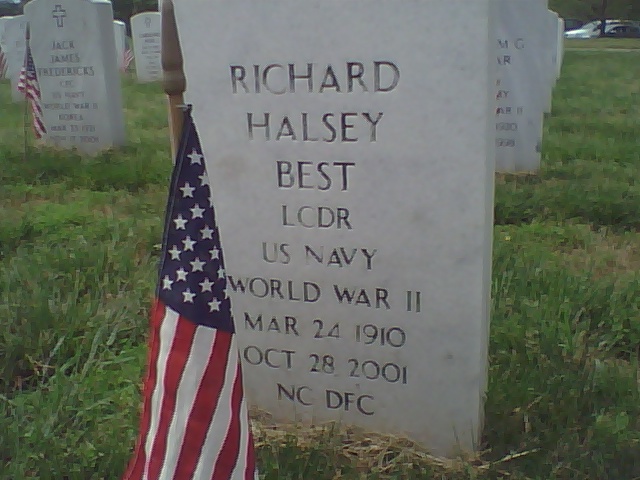
Arlington National Cemetery
Monday, May 25, 2009
1. The Caine Mutiny, Herman Wouk, 1951
2. Wikipedia – USS Missouri
3. Shattered Sword, “The Untold Story of the Battle of Midway,” Parshall & Tully, 2005
4. Ibid
5. Ibid
6. Miracle at Midway, Gordon Prange, 1982
7. Shattered Sword, “The Untold Story of the Battle of Midway,” Parshall & Tully, 2005
8. Ibid
9. Ibid
10. Ibid
11. Ibid
12. Ibid
13. Ibid


“Soldiers generally win battles; generals get credit for them."
- Napoleon Bonaparte

© Copyright 2008, Mountain Greenery Productions
Website design by KateKreations. For more information email kate@katekreations.com